Project Launch: Building a Structured AI Adoption Roadmap for Slovak companies
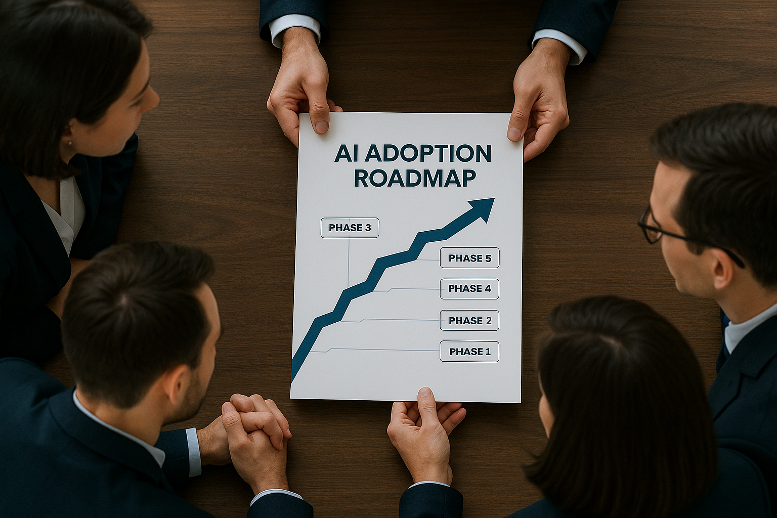
How the AI‑Impact project turns market evidence and advanced analysis into a low‑risk path to AI for Slovak companies
Context and Promise
For many owners and managers of Slovak small and medium-sized enterprises, artificial intelligence is now firmly on the agenda. The question is no longer whether AI matters, but how to approach it in a way that is safe, manageable, and aligned with real business performance.
At the same time, Slovak companies often operate with tight capacities. Management teams have limited time, specialist roles are stretched, and there is understandable skepticism towards generic promises about AI. What they need is not another high-level presentation, but a structured way to understand where AI makes sense for companies like theirs and how to move forward step by step.
The AI‑Impact project has been launched to respond to exactly this need. Over the coming months, it will combine market surveys, in-depth interviews, statistical and econometric analysis, comparative assessment, and scenario forecasting into one coherent programme of work. The outcome will be a set of concrete recommendations, guidelines, and best-practice materials that support AI-related decision-making in companies.
In short: we are launching this project to deliver a practical, field-tested AI adoption plan that managers in Slovak companies can trust and actually use.
The Project Solution: Initial Steps and Structure
The project is organised into several work packages that together form a structured AI adoption roadmap. Below, we convert these into five practical phases that matter for Slovak business decision makers.
Phase 1: Strong Governance and Smart Survey Design
The project starts with solid foundations. A dedicated work package focuses on project management and coordination. This includes setting up a clear governance framework, developing risk management and compliance guidelines, and preparing a detailed project management plan with defined responsibilities, milestones, and monitoring procedures.
From the outset, the team also designs the core market survey. This includes defining survey objectives and methodology, developing the questionnaire, and running internal review and pre-testing before the survey is finalised and approved. The project also covers the public procurement of a survey provider to execute the fieldwork professionally.
In parallel, the project establishes its web presence and communication channels, including a project website, social media and professional networking updates, newsletters, and webinars. These channels will later be used to share findings and practical outputs with companies.
What this means for a company manager
- The project is not an experiment on the fly. It is managed with governance, risk management, and compliance in mind from day one.
- Any survey or outreach that reaches your company will be based on a carefully tested questionnaire and a transparent methodology.
- You will have clear, accessible channels – website, newsletters, webinars – where you can follow the work and access outputs without needing to search for them.
Phase 2: Listening to Companies – Market Survey and In‑Depth Interviews
Once the foundations are in place, the project moves into systematic data collection. A dedicated work package covers a comprehensive market survey and qualitative research.
First, the team initiates the data collection process, monitors its progress, and conducts preliminary data cleaning and analysis. In parallel, they design and implement in-depth interviews based on a structured interview guide. Interviewers are trained in-house, interviews are conducted, transcribed, and analysed, and a first synthesis report is produced.
The project is explicitly designed to be iterative rather than one-off. After the first round of data collection and interview synthesis, the survey design is revised based on initial data and feedback. The instrument and interview protocol are then adjusted and approved, followed by a second round of data collection. Finally, qualitative and quantitative data are integrated into a comprehensive synthesis report that captures how companies are approaching AI over time.
What this means for a company manager
- The roadmap will be built on real experiences and expectations gathered from companies in the market, not on assumptions.
- The use of both survey data and in-depth interviews means that numbers are always interpreted in the context of real business stories and decisions.
- Because the research design is revised and repeated, the project can capture changes and emerging trends, not just a single snapshot in time.
Phase 3: Making Sense of the Data – Statistical Analysis and Company Segmentation
With rich data collected, the project shifts towards advanced analysis. A dedicated work package focuses on data analysis and segmentation.
This phase begins with data preparation and integration, bringing together all relevant datasets into a form that can be analysed reliably. The team then conducts quantitative analysis and develops statistical models, documenting the results in a statistical analysis report.
A key element is the development of a company segmentation model. This involves building the segmentation, evaluating its quality, drafting a segmentation report, and then revising the segmentation after further data updates and model recalibration. In other words, companies are not treated as a single homogeneous group – the project identifies distinct segments with different characteristics and potentially different paths to AI adoption.
The analysis work also includes drawing preliminary policy implications based on the emerging patterns in the data.
What this means for a company manager
- The project recognises that a small manufacturing firm, a regional services company, and a growing export‑oriented business may face very different AI challenges.
- You will be able to see which segment your company is closest to and what that implies for realistic AI use cases and priorities.
- Early policy implications help align company-level decisions with the broader environment in which Slovak firms operate.
Phase 4: Testing Options – Comparative Analysis and Scenario Forecasting
The next phase builds on the statistical and segmentation work to look ahead. A specialised work package conducts comparative analysis and scenario forecasting.
Comparative analysis allows the project team to assess different patterns in the data, refine initial findings, and produce both an initial and an adjusted comparative analysis report. On top of this, scenario forecasting introduces a forward-looking perspective. Based on the evidence collected, the project models potential future scenarios and compiles a scenario forecasting report.
The phase culminates in a final policy implications report that brings these comparative and forward-looking insights together.
What this means for a company manager
- Instead of asking “What will happen if we invest in AI?” in the abstract, you will be able to look at structured scenarios grounded in data.
- Comparative analysis shows how different types of companies or strategies fare relative to each other, helping you benchmark your own plans.
- The policy implications report offers a broader view of how AI adoption might evolve in the business environment in which you operate.
Phase 5: From Insights to Action – Business Impact, Guidelines, and Knowledge Transfer
Finally, the project goes deeper into the relationship between AI and business performance and then translates insights into actionable guidance.
A dedicated work package conducts deep data analysis and interpretation. This involves defining econometric model variables and relationships, preparing structured datasets, estimating models, running robustness checks and sensitivity analyses, and validating results. The team then uses these results to interpret business strategy implications, identify key opportunities and risks of AI adoption for firms, and draft recommendations for AI adoption frameworks. These insights are compiled into structured reports and refined through internal review.
In parallel, the knowledge transfer and policy implications work package focuses on turning analysis into practice. Its deliverables include a Policy Recommendations Report, a series of open-access webinars, and a Guidelines and Best Practices Manual. Throughout the project, these outputs are supported by ongoing communication via the project website, social media, newsletters, and organised webinars.
What this means for a company manager
- You will not be expected to interpret complex statistical or econometric models on your own – the project team will translate them into clear recommendations and frameworks.
- The Guidelines and Best Practices Manual will offer structured, practical suggestions that you can apply in your own planning and implementation.
- Open-access webinars and other communication channels will make it easier to learn from the project, ask questions, and see how others are approaching similar decisions.
How This Methodology Helps Slovak companies Adopt AI with Confidence
Taken together, these phases form a structured, evidence-based approach to AI adoption.
The project starts by managing risk and governance, then listens carefully to companies through surveys and interviews, and only then moves into advanced modelling and scenario analysis. Throughout, it uses internal reviews, model validation, robustness checks, and iterative revisions to ensure that findings are reliable.
For Slovak companies with limited internal analytical capacity, this matters. The heavy lifting – from survey design and data collection to segmentation, econometric analysis, and scenario forecasting – is done within the project. The outputs are designed to be accessible: policy recommendations, guidelines, best-practice materials, and webinars that help you understand where AI can make a difference in your business, and what risks you should be aware of.
Instead of a one-off study or a generic checklist, you gain access to a comprehensive roadmap that evolves as new data and insights become available.
Stay with Us on the Journey
Building and implementing this roadmap is an ongoing process. As the project moves through its phases – from survey design to data collection, analysis, forecasting, and knowledge transfer – we will share what we learn in a form that is relevant for Slovak company leaders.
Want to follow our journey and see the outcomes of this structured approach in real time? Follow our project updates and future announcements.
Follow our work and updates on LinkedIn: https://www.linkedin.com/company/ai-impactsk/
Related posts